
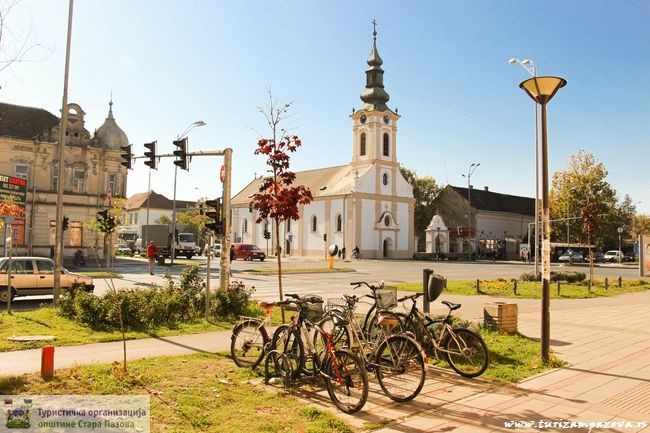
How did Pazova get its name…
The very name Pazova is most likely derived from the word armpit (Serbian: pazuh), because the Slavs thus called the Roman military borderline plateau between the two great rivers – the Danube and the Sava. Pazova is mentioned at the end of the 15th century. The basic ethnic core on the territory of the municipality was formed by the settling of Serbs in today’s Vojvodina under Arsenije Čarnojević’s leadership in the late 17th century (1690). It was mentioned as a settlement in 1716. During the 17th and 18th century, the migration of the population was organized by Maria Theresa and her son Josip 2 in order to strengthen the border of the Military Krajina. Since the formation of the Croatian-Slavonian military border in 1750, Pazova has become a border town, a military-agricultural settlement. Srem, as a part of the Austrian military border, guaranteed to the new immigrants the freedom to their own property, education in their mother tongue and freedom of religion. The original settlement was in the territory of Staro selo between the Surduk-Belegiš road that is about 2 km away. By tradition, it is known that the natives left the settlement in the period from 1760-1770 due to high waters and in search of a higher terrain they settled in the east of the Orthodox Church (Serbian region). Soon after the relocation of the old settlers, the Serbs from Lika joined in. At the end of the 18th century, more precisely in 1770, Slovaks immigrated to this area. The present name Stara Pazova dates back to 1792. The Germans settled the year before. They got the land south of Pazova and called that place Nova Pazova. They called it like that as a sign of gratitude to the locals of Pazova, in whose houses they had wintered upon arrival, and who helped them build houses. The Orthodox Romanians and Calvinist Hungarians, who eventually assimilated, also came to Stara Pazova. The Serbs and Slovaks built houses in a Pannonian type, placed longitudinally on the lands. The local government ordered a linear settlement. The houses were built in a simple way, with two to three sections, low, with small windows and covered with reed. Not until the middle of the 19th century, and especially at the beginning of the 20th century, the houses were made of brick and tile roof, so there were five brickyards in Stara Pazova.
Most often they built houses raised on the foundation with the insulation and with more windows. The water was drunk from wells from which the whole environment was supplied with. Later on, there was a well in each yard. In 1934, Stara Pazova began to supply water from the artificial wells with greater depths. The main, broad streets, got a Turkish cobblestone until the end of the 19th century – a macadam, and in the summer, the clouds of dust were raised by a carriage. Only the rich families tiled their yards with brick between the two wars. The grain was flushed manually and only in the beginning of the 20th century, the scales were used. Steam-powered machines have made great progress in agriculture. Until the Second World War hemp was cultivated in Stara Pazova. Since 1801, the breeding of mulberries was ordered, which were planted in wide streets in two rows, so our ancestors were good breeders of silk and mulberry brandy. The development of agriculture was followed by the following crafts: furriers, wheelwhrites, blacksmiths, saddlers, opanci makers, hatters. Since the 19th century, the market of Pazova was very famous. At the beginning of the 20th century, the industrial buildings included brickyards, and since 1936, a factory for the production of ice and soda called Ledara. One of the most important buildings in Stara Pazova which mark the place from 1905, are the hotel and bank, built by Nikola Petrović, one of the richest people in this part of Srem. The construction of the present Orthodox Church began in 1827 not far from the first church for which there is no preserved data. The church is dedicated to St. Prophet Elijah. Thus, the people from the surrounding places gather on the 2nd of August. According to the tradition, the chapel was built in the second half of the 19th century by the shepherd to whom St.Elijah appeared in a dream. The building of the Slovak Evangelical Church dates from 1788 and was built on the site of the destroyed church. The church building and the church school were built in 1894. According to the written records, there has been a a Serbian national elementary school from 1730, and the Slovak National Primary School mentioned in 1774. The craft schools, agricultural cooperatives, banks, health centers, public baths, libraries, various courses are established here. Later on, a military garrison and a district court were established. The Pazova reading room was founded on July 12, 1878. Thanks to the fact that it was an international railway node, Stara Pazova became a town in 1883, and thus the commercial core of Serbia and Hungary. The advanced ideas of its citizens have put Stara Pazova among those European cities that have introduced electric power among the first. From 1895, Stara Pazova was supplied with electric current for lighting from the steam mill. Great banks, schools and cultural institutions were formed here. In 1881, a group of actors from the Serbian National Theater was here. The spirit of the national and cultural reciprocity between the Serbs and the Slovaks grew stronger over time. Joint theater performances, concerts and reading meetings were organized. Later on, the first Slovak party was organized in 1902. Soon, the Slovak public reading room began to organize theater parties each year. Then, in 1923, the idea of building a national home as the center of Yugoslav Slovaks and Czechs arose, and in 1928 the first Slovak National Home was built in Stara Pazova as a Slovak institution in the diaspora. It could receive an incredible number of spectators – even 1300! However, the position of the city was a problem at war time. This is borne out by the fact that one of the fronts of the First World War in 1914 had reached even the rural environment of Stara Pazova and that during the Second World War there was a strong defensive line of the German General Staff between the German villages Nova Pazova and Inđija and the partisan villages Vojka, Belegiš and Surduk. After the end of the Second World War, the city of Stara Pazova was one of the most attractive locations for the colonists from Bosnia and Herzegovina, Croatia and Kosovo. During the recent war, from 1991 to 1999, many refugees from Croatia, Bosnia and Herzegovina and Kosovo were frequently rescued here. The mechanical influx of the population was then too great.
